
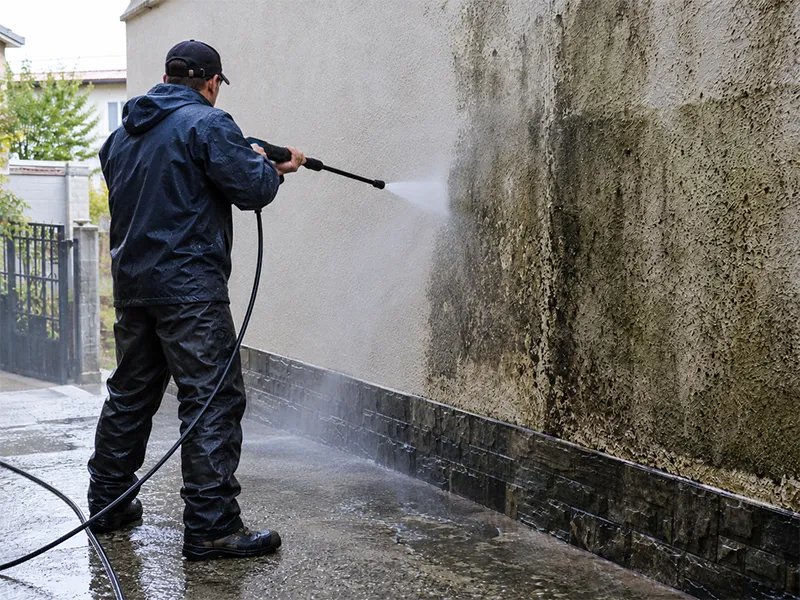
Most people use “pressure cleaning” as a catch-all term for getting the outside of a property clean. In practice there are two quite different methods, and using the wrong one on the wrong surface is how a straightforward clean turns into a repair bill. Knowing which is which helps you ask better questions before anyone turns a hose on your house.
What High Pressure Cleaning Actually Does
High pressure cleaning uses water force to physically blast dirt off a surface. It is fast, it is effective, and on the right materials it is the obvious choice.
Concrete driveways, paths, brick paving and retaining walls all hold up well to it. These surfaces are hard, non-porous enough to cope, and usually carry the kind of built-up grime, oil staining and ingrained dirt that needs force to shift. If your driveway has gone from light grey to charcoal over a few years, high pressure is what brings it back.
The limitation is that pressure does not distinguish between dirt and the surface underneath. On anything softer or more delicate, the same force that removes grime also removes the finish.
What Softwashing Does Differently
Softwashing works the other way around. Instead of force, it relies on a cleaning solution to break down mould, algae, lichen and grime, followed by a gentle low-pressure rinse. The chemistry does the work, not the water.
That makes it the right approach for render, painted walls, cladding, timber and most roofing. It also tends to last longer on organic growth, because treating mould and algae at the source slows down how quickly it comes back, rather than just removing what you can see.
For coastal properties this matters more than it might further inland. Shaded south-facing walls, fence lines under trees and anything that stays damp after rain all tend to grow mould faster here, and a plain water blast on those surfaces removes the staining without touching what is causing it.
Surfaces Where High Pressure Is the Wrong Call
A few surfaces come up often enough to be worth naming directly.
Roofs. Monier, one of Australia’s largest roof tile manufacturers, strongly advises against using pressure washers for roof cleaning, citing the risk of tile damage. Their guidance is that roof cleaning should be left to a qualified professional using appropriate methods. The same caution applies to coated steel roofing, where BlueScope’s maintenance guidance recommends gentler washing rather than a full-pressure blast.
Render and painted surfaces. Too much pressure strips paint, lifts render and can force water in behind cladding where it has no way to dry out. On a painted exterior, a high pressure clean can take years off the life of the paintwork in an afternoon.
Timber decking and fencing. Timber splinters and furs up under high pressure. It can be cleaned well, but at a much lower pressure and with the right technique.
The One That Is Not Negotiable: Asbestos
If your property was built before the late 1980s, there is a reasonable chance it contains asbestos cement sheeting, commonly called fibro. It turns up in wall cladding, eaves, fences, gutters and roofing on plenty of older Central Coast homes.
SafeWork NSW lists high-pressure water spray among the equipment that must never be used on asbestos or asbestos-containing material. Blasting it breaks down the surface and spreads contaminated residue across the property and often onto neighbouring ones, and the clean-up has to be done by a licensed asbestos removalist at considerable cost.
This is not a reason to panic about an older home. Well-maintained asbestos cement left undisturbed is not the problem. It is a reason to make sure whoever cleans your property knows what they are looking at before they start, and to say something if you think your place might have fibro anywhere on it.
How We Decide on Your Property
In practice most jobs are a mix. A typical house wash might mean high pressure on the driveway and paths, and a softwash across the render, eaves and fence line. We work out which is which on site rather than applying one method to the whole property.
Our high pressure cleaning service covers both approaches, including softwashing with biodegradable solutions for the surfaces that need a gentler touch. If something on your property should not be cleaned at all, we will tell you that too.
If a Repaint Is on the Horizon
Cleaning and painting often come up in the same conversation. A wash is the right first step before an exterior repaint, since paint will not bond properly to a salt-and-grime-covered surface. Just allow a day or two of drying time in between rather than booking them back to back.
Sometimes a clean is enough on its own and buys the paintwork another year or two. Sometimes it reveals that the paint underneath is genuinely past it. Either way, you end up with a clearer picture of what the property actually needs.
Related Reading
- How Often Should You Repaint Your Home on the Central Coast?, useful if the wash reveals tired paintwork underneath
- Why Pressure Cleaning Before You Sell Adds Value to Your Property, what to prioritise if you are listing soon
Not Sure Which Your Property Needs?
Give the team at ECE Paint Crew a call on 0423 526 896 or get in touch through our contact page. We will have a look at what you have got, tell you which surfaces suit which method, and give you an honest read on whether a clean is all you need or whether the paintwork is due for attention as well.