
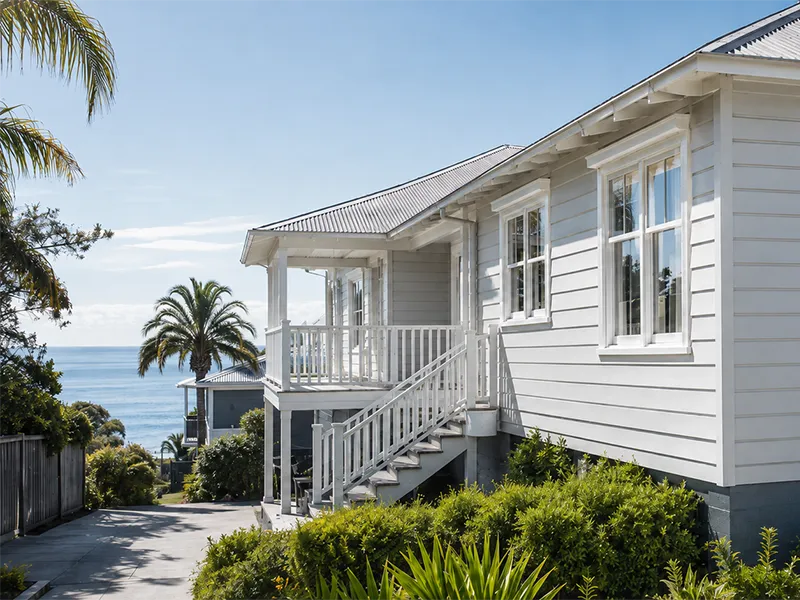
If you’re weighing up whether it’s time to repaint, the honest answer is: it depends on where you live, not just how old the paint is. A home in Erina behaves differently to one further inland, and a house two streets back from Terrigal Beach ages differently again from one set well away from the water. Understanding what’s actually working against your paintwork helps you plan ahead, rather than being caught out by peeling walls or a faded exterior right when you’re trying to sell.
Why the Central Coast Is Tougher on Paint Than Most Places
Coastal living comes with a trade-off. The same sea breeze that makes summer evenings on the deck so pleasant also carries fine salt particles that settle on your walls, window frames and gutters. Combined with strong UV exposure and the humidity that rolls in off the water, exterior paint on the Central Coast works harder than it would inland.
Salt residue draws moisture, which slowly breaks down the bond between paint and surface. UV rays fade colour and dry out the paint film until it starts to chalk. In suburbs like Avoca Beach, Wamberal and Terrigal, that combination tends to show up sooner than homeowners expect, and it’s not always obvious until you’re standing close enough to see it.
It’s part of why paint manufacturers like Dulux recommend washing exterior paintwork roughly twice a year in coastal and industrial areas, compared to once a year further inland. Regular washing alone won’t replace a repaint when one’s needed, but it does slow down how fast salt and grime take their toll.
A Realistic Repaint Timeline for Coastal Homes
As a general guide, exterior paint on Australian homes lasts somewhere between five and ten years. Move closer to the water, and that window tightens. Homes within a few streets of the coast often need attention closer to the five-year mark, particularly on north and west-facing walls that cop the most sun through the day.
A few things shift that timeline in either direction:
- Surface material matters. Timber weatherboard needs repainting more often than brick or rendered surfaces, which tend to hold their coating longer.
- Aspect matters too. Walls facing the prevailing weather and afternoon sun fade and chalk faster than sheltered sides of the house.
- Paint quality plays a real role. A premium exterior coating applied properly will comfortably outlast a budget product, even under the same conditions.
- Interior surfaces follow a different clock. Away from the weather, high-traffic areas like hallways and kitchens usually want a refresh every five to seven years, while quieter rooms can often go longer between coats.
Whether it’s a full exterior repaint or just the weatherboards and trims, our residential painting team can tell you what your home actually needs rather than a generic recommendation.
Signs Your Paint Job Is on Borrowed Time
You don’t need to wait for obvious peeling to know it’s time. Keep an eye out for a few tell-tale signs. Chalky residue that rubs off on your hand when you touch an exterior wall is one of the earliest indicators. Fading that’s noticeably more advanced on one side of the house than another is another. Small cracks appearing around window frames and joints, bubbling or lifting paint after wet weather, and timber that feels soft or looks grey where the coating has worn through are all worth acting on.
Catching these early usually means a straightforward repaint. Left too long, and you’re looking at more extensive preparation, and sometimes timber repairs, before a new coat can even go on.
The Best Time of Year to Repaint
Timing matters almost as much as preparation. Bureau of Meteorology rainfall records for the Gosford area show spring, particularly September and November, as typically the driest stretch of the year, which makes it a reliable window for exterior work. Autumn can catch people out, since March is often the wettest month on the Central Coast, so it’s worth checking the outlook rather than assuming the season alone will cooperate. Paint needs a stable, dry surface to bond properly, so a rushed job squeezed into a wet week rarely holds up as well as one done in the right conditions.
That said, waiting for the “perfect” season shouldn’t mean ignoring paintwork that’s already failing. If your walls are chalking or peeling now, it’s usually better to get it sorted than to let another summer of sun and salt make the job bigger than it needs to be.
How Proper Preparation Extends the Life of Your Paint
This is where most of the value in a repaint actually sits. Salt and grime need to come off the surface before anything else happens, which is why a pressure clean is often the right first step rather than an afterthought. From there, proper preparation means addressing cracks, sanding back chalky or flaking areas, and priming surfaces that need it, before a quality coating goes on.
Skip these steps and even the best paint will fail early. It’s the difference between a repaint that holds up for eight or nine years and one that starts showing wear within three.
It’s also worth remembering that a repaint and a pressure clean don’t always need to happen at the same time. Sometimes a thorough clean is enough to buy your paintwork another year or two, and a straight answer about which one you actually need can save you money either way.
Related Reading
- Preparing Your Home Before the Painters Arrive, what to sort out once you’ve decided a repaint’s on the cards
- Why Pressure Cleaning Before You Sell Adds Value to Your Property, sometimes a wash is the smarter first move
- 2026 Interior Paint Colour Trends for Central Coast Homes, worth thinking about at the same time as your repaint timeline
Get a Straight Answer for Your Property
Every home on the Central Coast ages a little differently depending on its position, aspect and the materials it’s built from. If you’re not sure where your place sits on that timeline, we’re happy to take a look and give you an honest answer, not just an upsell.
Give the team at ECE Paint Crew a call on 0423 526 896 for a free assessment, or get in touch through our contact page. With over 20 years working on homes across Gosford, Erina, Terrigal, Avoca Beach, Wamberal and the surrounding suburbs, we can usually tell you pretty quickly whether you’ve got a few years left or whether it’s worth getting in now.